Three foundation modules and a drawbridge capstone establish a shared engineering language. Each is a starting point for changing the structure, mechanism, constraints, or application—not a single prescribed solution.
Geometry, triangulation, corrugation, modularity, tension, compression, and load paths.
Explore the challenge, evidence & application +
The challenge
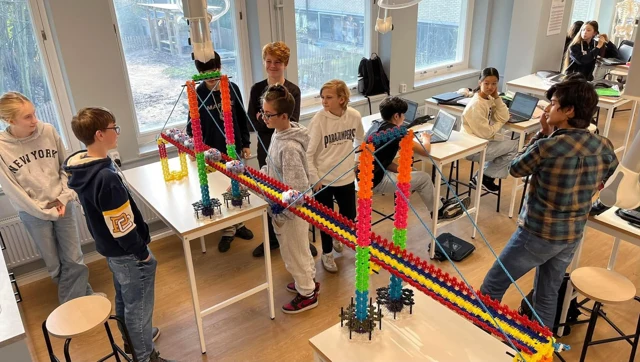
Build a bridge or frame under a defined parts and load constraint. Compare a flat arrangement with a folded or braced one. Revise the geometry, then test again.
Learning made visible
A labeled sketch, repeatable test record, and explanation of how the revision changes the structure.
Real application
Construction, fabrication, and the frames that support moving machinery.
02
Foundation module
Mechanical Advantage
How can a mechanism trade movement for force?
Levers, pivots, pulleys, torque, and input–output relationships.
Explore the challenge, evidence & application +
The challenge
Raise the same teacher-approved load using two arrangements. Compare required input force and distance with appropriate measuring tools.
Learning made visible
A prediction, measurements, and an explanation of the tradeoff. Mechanical advantage does not create energy.
Real application
Hoists, hand tools, lifting systems, and material handling.
03
Foundation module
Gears & Power Transmission
How can a fast input become a useful output?
Gear ratios, speed reduction, torque multiplication, shafts, alignment, and friction.
Explore the challenge, evidence & application +
The challenge
Build two different gear reductions. Compare rotation and use the same task to investigate which arrangement is useful.
Learning made visible
Rotation counts, a ratio calculation, and a reasoned choice of gearing. Distinguish ideal predictions from measured performance.
Real application
Drivetrains, manufacturing equipment, mechanical maintenance, and robotics.
The Lux Blox structural grammar
Familiar pieces. First principles in action.
Students investigate how a fold changes a structure, how a cable carries tension, and how connected hinges guide motion. They predict, measure and revise an arrangement before explaining the result.
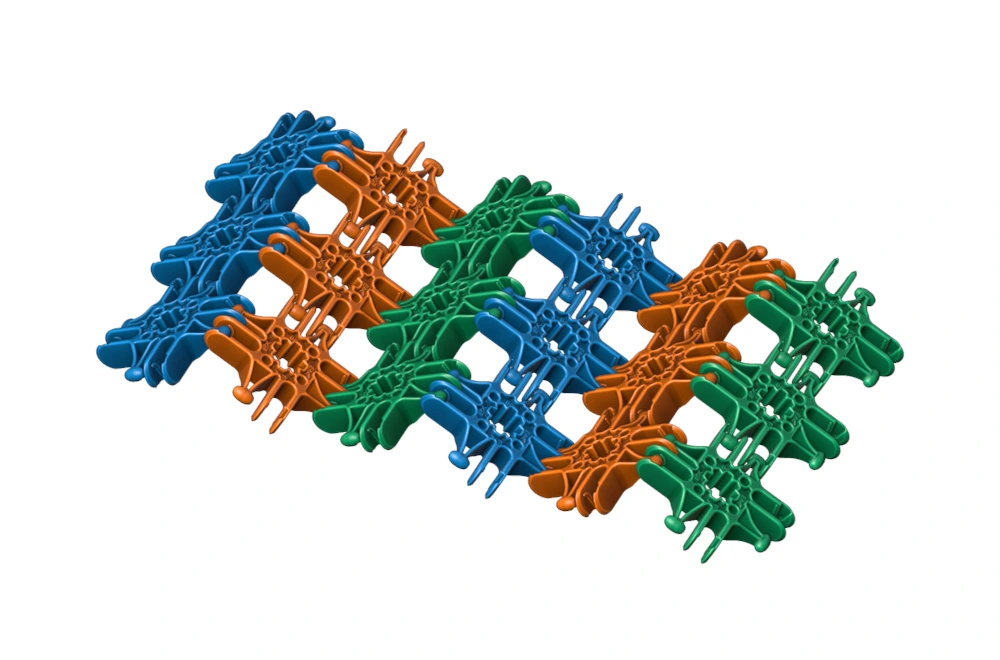
CorrugationCompare flat and folded arrangements under the same span and test load. Restrain the folds, then measure bending.KinematicsFollow the Sarrus-type folding animation. Compare hinge angles, extension and constraints.Tension & compressionTrace the load through added cables and Lux Blox towers. Optimize a model by comparing measurements within the same material and load constraints.
Take the principles further: corrugation, modularity & kinematics +
Corrugation
Compare flat and folded arrangements. Investigate how geometry changes resistance to bending, using the same materials and test conditions.
Modularity
Repeat a useful unit. Change a span or assembly and investigate how local connections contribute to the whole structure.
Kinematics
Follow a hinge or linkage. Compare how joint placement permits movement, then apply that observation to the drawbridge or a new mechanism.
These are ways to extend the Launch Lab investigations into architectural studies, engineering models, and manufacturing-relevant mechanisms.
04 / Working-machine capstone
Can your bridge lift its own deck?
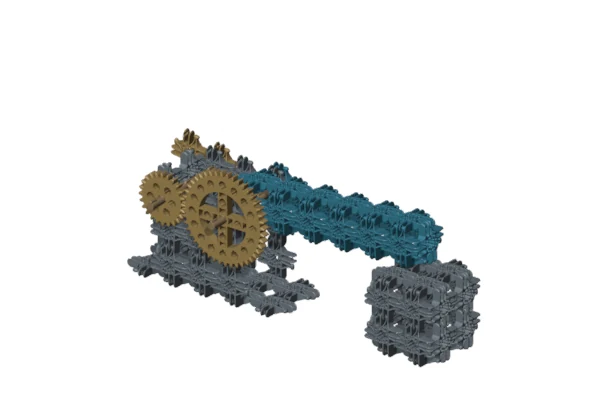
Put structure, gearing, alignment, and movement to work in one student-built machine. Then change the design brief: a wider opening, a different deck, or another lifting task. The principles carry into new solutions.
Build: make a supported, hand-operated drawbridge.
Test: compare gearing and record the deck’s movement.
Improve: diagnose binding, slipping, or frame movement.
Power: add a matched low-voltage motor and manual control.
Explain: defend the design using sketches and test evidence.
Teacher-supervised model testing uses defined loads and a clear movement zone. Start by hand before introducing power.
Earlier stock-axle drawbridge · design illustration. It does not demonstrate the adjustable-counterweight project in development.
Try a first-principles question
What changes with the ratio?
At an input speed of 60 rpm, predict how fast the driven gear turns. Then compare your prediction with a physical mechanism.
This is an ideal single-stage calculation, not a load simulation. External gears turn in opposite directions; real mechanisms have losses.
5.80:1 reduction. Ideal output torque is 5.80× input torque, before losses.
Later modules extend the same foundations into mechanisms and motion, an engineering design studio, and programmable robotics. Gantry cranes, lifting linkages, and other advanced machine challenges belong in this progression.
The Spring 2027 core concludes with a motorized, manually controlled machine. Sensors, microcontrollers, programming, and advanced simulation are later extensions.
Let’s talk about your classroom.
Give students a machine to figure out.
Ask about the Spring 2027 Launch Lab and the right starting point for your course.