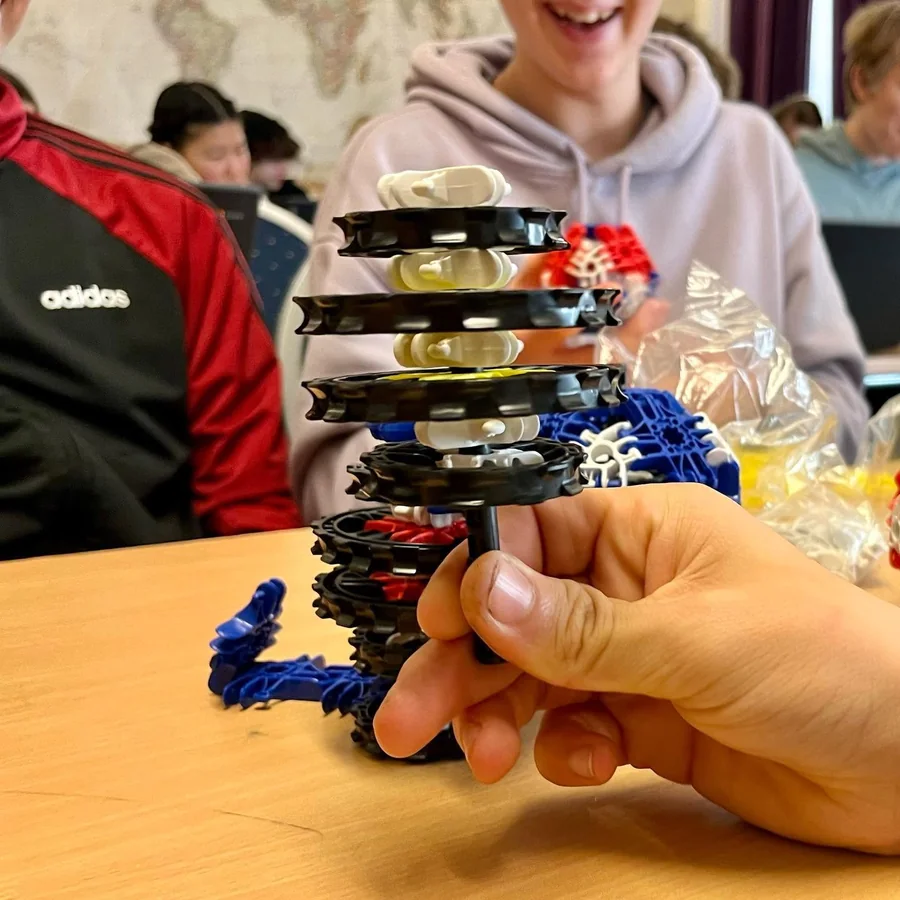
Explore how observation, model building, and explanation can make structural reasoning visible.
A model gives learners something they can point to, describe and explain. F.R.E.S.H. project, Lund, Sweden.
Try the learning sequence in biology, chemistry, or mechanics: predict, build, observe, explain, and transfer. Record your own evidence, then compare your answers with the multiple-choice explanations. Open responses are for reflection and discussion with an educator; these sample activities do not automatically grade them.
These formative examples demonstrate the approach. They do not produce validated learning-growth or diagnostic scores.
What You Can Try
Structure Smart™ Assessment Platform
Biology Explore veins, ribs, shells, and controlled movement
Chemistry Compare connections, chains, layers, and carbon model patterns
Structure and mechanics Explore supports, braces, joints, and load paths
Activity review Read answer-key explanations and discuss your observations
From a Model to an Explanation
Use physical LuxBlox pieces or the 3D builder to explore shape and connections. Models simplify real systems: a geometry model does not simulate molecular bonds or all the functions of a living structure. Compare what your model can show with what needs observation or further testing.
Illustrative student response · A written example for teacher discussion
“I thought both openings would squash. When we pushed gently, the four-sided opening became slanted and the panels stayed joined. The triangle’s opening changed much less. I think the four sides let the hinges turn and change the corner angles, but the closed triangle kept its shape. A diagonal brace might stop a gate from slanting because it makes triangles. I would compare the same gate with and without a brace. Our hand pushes were not exactly equal, so I would repeat the test.”
A teacher’s next question: “Point to the angles that changed in your sketch. What would you keep the same when testing the gate?” Use the student’s actual observations, even when they differ from this example.
A simple formative rubric
Choose a description for each criterion and note one next step. Use these descriptions for feedback and discussion; no total score is required.
Observation & comparison
Starting
Names a shape without describing a test.
Developing
Describes movement in one model.
Clear evidence
Compares both models using observations and labeled sketches.
Explanation from evidence
Starting
Gives a claim without a reason.
Developing
Links the claim to an observation, with prompting.
Clear evidence
Connects observed angle changes to hinges and the closed shape; recognizes model limits.
Transfer & next test
Starting
Repeats the original result without a new application.
Developing
Predicts an effect of a gate brace.
Clear evidence
Explains the prediction and proposes a comparison of a gate with and without a brace.
This is teacher-led classroom assessment. The illustrative response and rubric have not been validated as learning-growth, diagnostic or standardized measures. They do not establish gains or provide comparisons between students, classes or schools.