Mathematics · Structure Smart
Build a patternFind the mathematics
Give numbers, shapes and relationships something students can work with. Arrange, count, turn and rebuild—then connect what students notice to the mathematics you already teach.
Number · Multiplication · Area & perimeter
Same twelve pieces
A different arrangement
Start with a question students can test: can two arrangements contain the same number of cells and have different perimeters? Change the rows and columns, then make the comparison with physical pieces.
3 × 4 = 1212 unit cells · Perimeter: 14 unit lengths
A counting diagram of unit squares. With Lux Blox, count each square piece as one cell; the diagram models a grid, rather than the plastic surface or connector dimensions.
Try it with twelve Lux Squares
Objective: explain how equal groups represent multiplication, and how rearranging twelve unit cells can change the perimeter while preserving the cell count.
Materials per group: twelve Lux Square pieces, squared paper and a pencil. Lay the pieces flat in rows; joining them is optional for this investigation.
- Predict. Ask whether a 3 × 4 array and a 2 × 6 array have the same count and the same boundary length.
- Arrange and record. Make each array. Sketch its unit cells, count by equal rows and trace the outside boundary on the sketch.
- Explain. Compare twelve cells in both arrays with perimeters of 14 and 16 unit lengths. Describe why one quantity stays the same while the other changes.
- Transfer. Draw a garden plan with twelve unit plots. Find another arrangement and explain what its boundary would require.
Adapt the question: begin with counting equal rows; extend to factor pairs, the commutative property, or which rectangular arrangement gives the shortest boundary for a fixed whole-number cell count.
“Both arrays have twelve cells. Three rows of four and two rows of six give the same product. But the longer, narrower array has more edges around the outside: sixteen instead of fourteen.”
Illustrative student explanation · A prompt for discussion and formative feedback
Geometry · Angles · Spatial reasoning
Geometry that moves
Questions that stay with you
Follow one hinge as a connected model folds. Which angles change? Which parts remain connected? Sketch two configurations and explain how you could get from one to the other.
Move between the object, a drawing and a description. Ask a partner to predict a view from another side, or describe a movement clearly enough for someone else to reproduce it.
Teach the first hinged-form lesson →Ratios · Measurement · Prediction
Count the turns
Describe the relationship
Mark an input gear and an output gear in a physical model. Count their turns over several cycles, record the results and express the relationship as a ratio. Use it to predict the output before turning the input again.
Change one gear and investigate what changes. Keep the direction of rotation, the number of turns and the elapsed time as separate observations.
Explore the planned gear kits →Repetition · Scale · Fractal patterns
A small rule
A larger world of patterns
Find a small arrangement within a larger construction. Where does it appear again? Compare the repeated forms, the spaces between them and the changes in scale.
A finite physical model offers a starting point for self-similarity and iteration. Students can describe a construction rule, sketch its next stage and decide which features repeat. More advanced investigations can compare a recursive model with its mathematical idealization.
Continue into university investigations →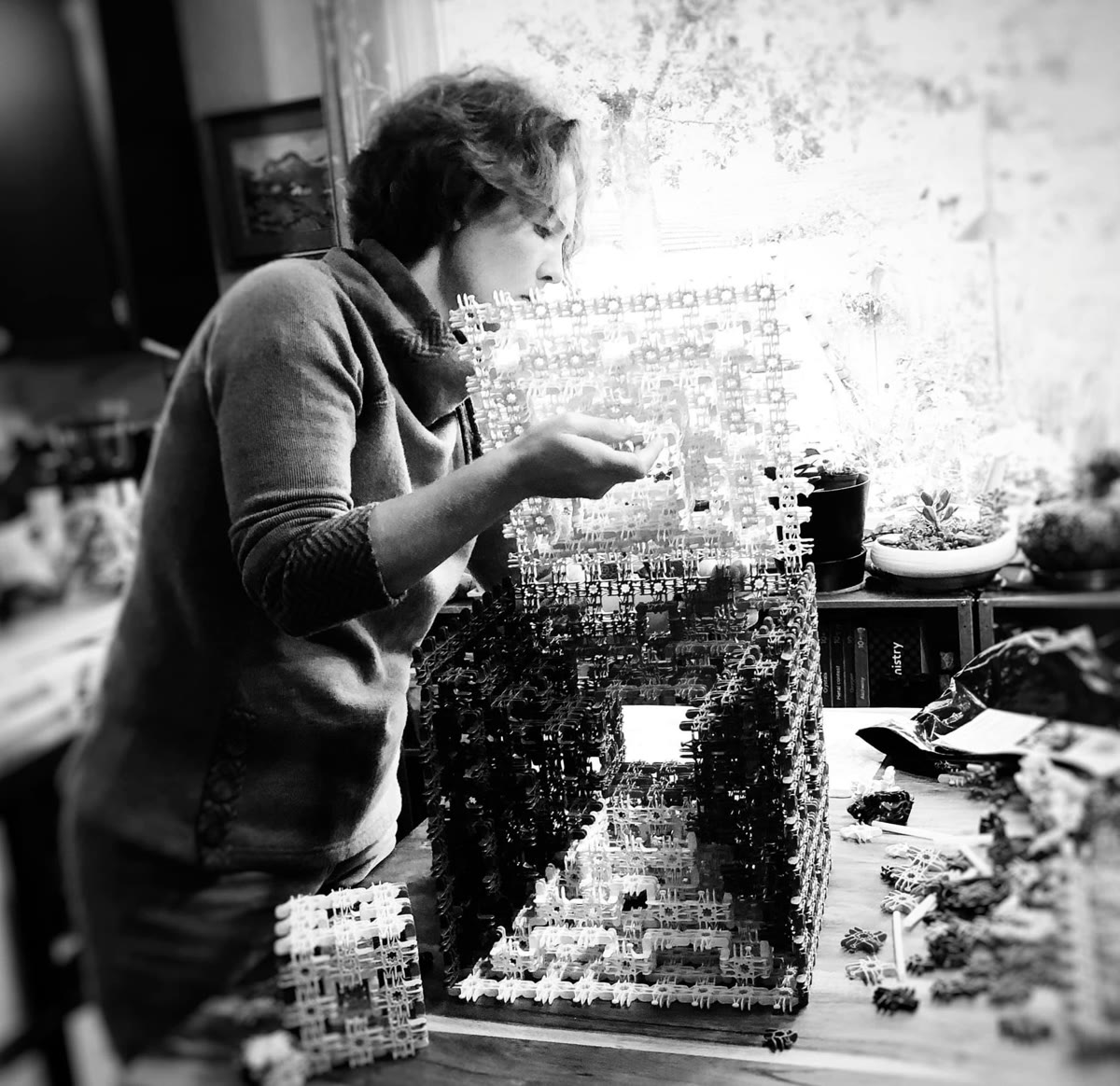
Build on the lesson you already teach
From “I noticed” to “I can explain”
Invite a labeled sketch, a number sentence and an explanation that connects the two. These starting points can be adapted to your learners and curriculum; the classroom activities on this page have not yet been field-tested as a complete lesson sequence.