The Structure Smart difference
Fewer Parts.
More Possibilities.
A simple structural grammar for complex thinking.
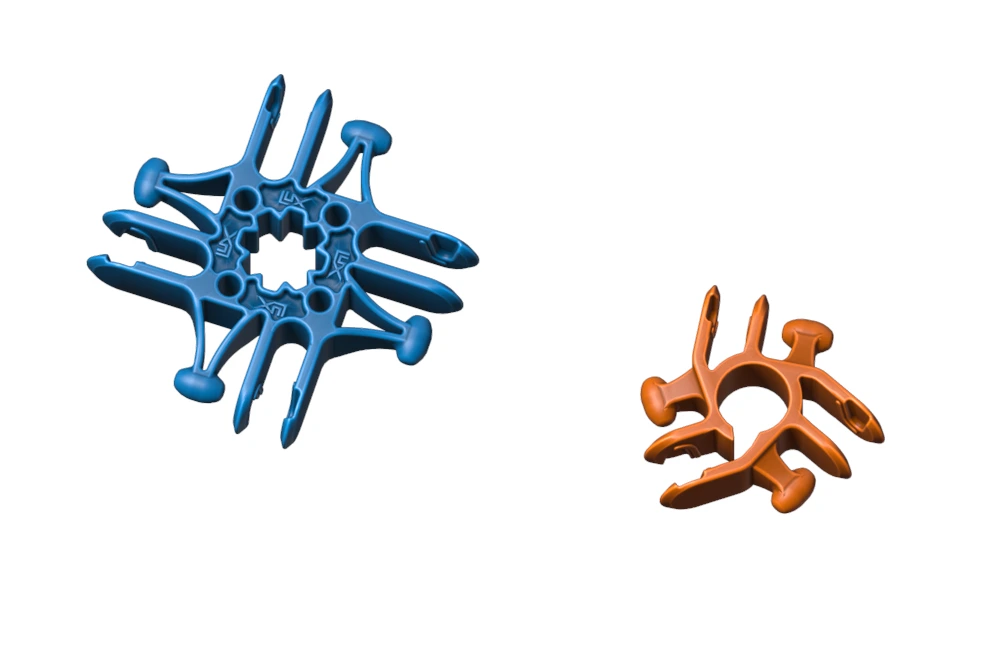
Begin with the real Lux Blox pieces.
The Lux square and Trigon have a recognizable geometry of their own. Look closely at the edge connectors: the relationships begin there.
Lux Blox begins with a deliberately small foundational vocabulary: squares and triangles. Complexity grows from how students connect, repeat and arrange those familiar elements.
The complexity isn’t hidden in the pieces.
It emerges from the thinking of the builder.
01 · A deliberate design decision
Construction Is a Language.
A small vocabulary.
An enormous expressive range.
Language becomes powerful through the relationships between familiar symbols. A limited alphabet can express an extraordinary range of ideas. Construction can work in a similar way.
In Lux Blox, squares and triangles establish the foundational structural vocabulary. Connections, repetition, bending and arrangement establish relationships. The structures students invent are the expressions.
This simplicity is intentional. The aim is to let familiarity with the elements free more attention for design, experimentation and problem-solving. Students investigate, compare and explain what their own builds do.
Two familiar shapes.
Start with the pieces. Look at the connections they make possible.
Look closely at the pieces ↑Connect. Repeat. Vary.
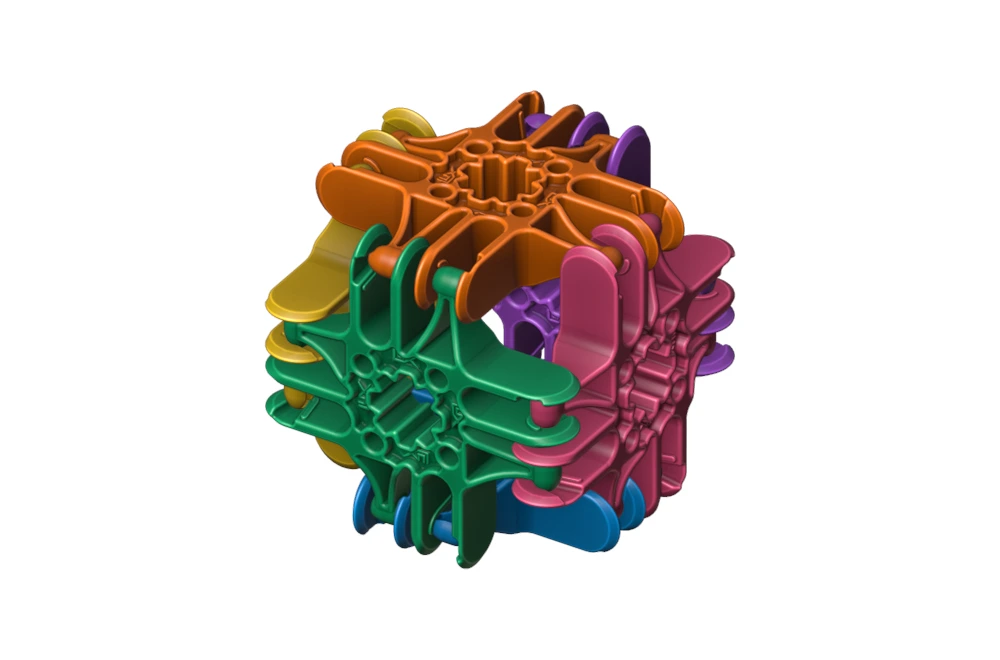
Join familiar shapes. Discover a 3D form.
A structure of your own.
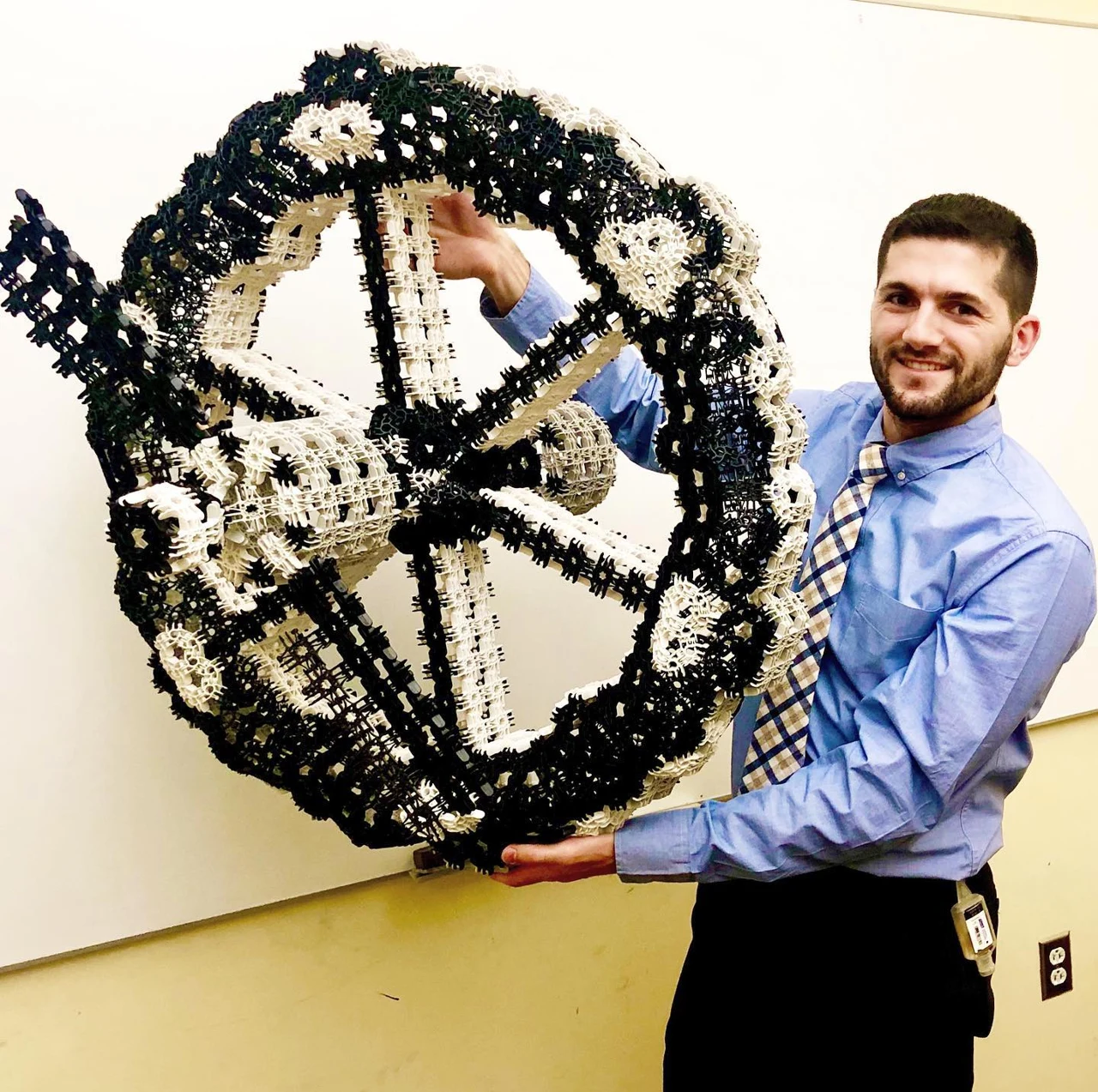
A builder’s idea, made real.
Same starting pieces. Different connections. What could you make possible?
02 · Fluency creates freedom
Less Searching. More Thinking.
Specialized construction components have useful roles, especially in engineering and robotics. Lux Blox takes a deliberately simple approach to the foundational structures beneath those applications.
Rapid fluency
A small vocabulary is intended to make the elements familiar, leaving more attention for the relationships between them.
Creative independence
Familiar elements can be recombined into original structures, with more than one response to a design brief.
Transferable understanding
A relationship noticed in one model becomes a question students can investigate in another.
Rapid iteration
Reconnect, compare and rebuild with materials students already know. Keep a record of what each revision changes.
Progressive complexity
Retain the foundational vocabulary while extending the geometry, scale, constraints and purpose of a challenge.
The goal is not simply to make construction easier.
It is to make complex thinking more accessible.
03 · Complexity emerges from relationships
From Geometry to Engineering.
Each new challenge carries something forward. A familiar face becomes a volume; a useful frame supports a mechanism; a machine must do a job under real constraints.
Two familiar starting shapes Shapes
Notice squares and triangles.
Six squares become a cube Geometry
Describe faces, edges, vertices and spatial relationships.
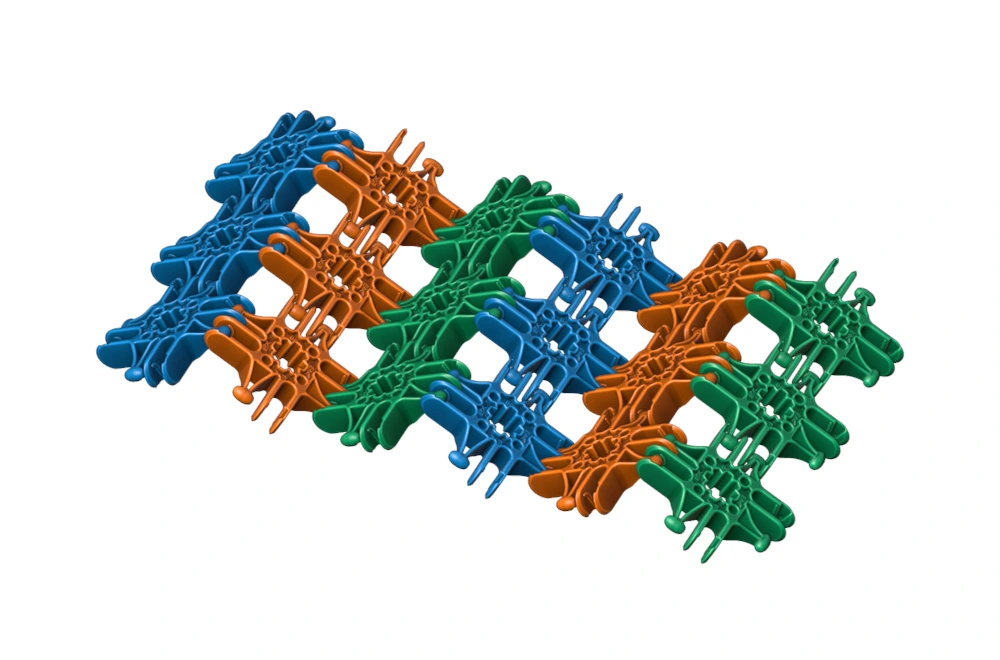
Fold a sheet. Change its shape. Structures
Combine frames, trusses, towers and bridges.
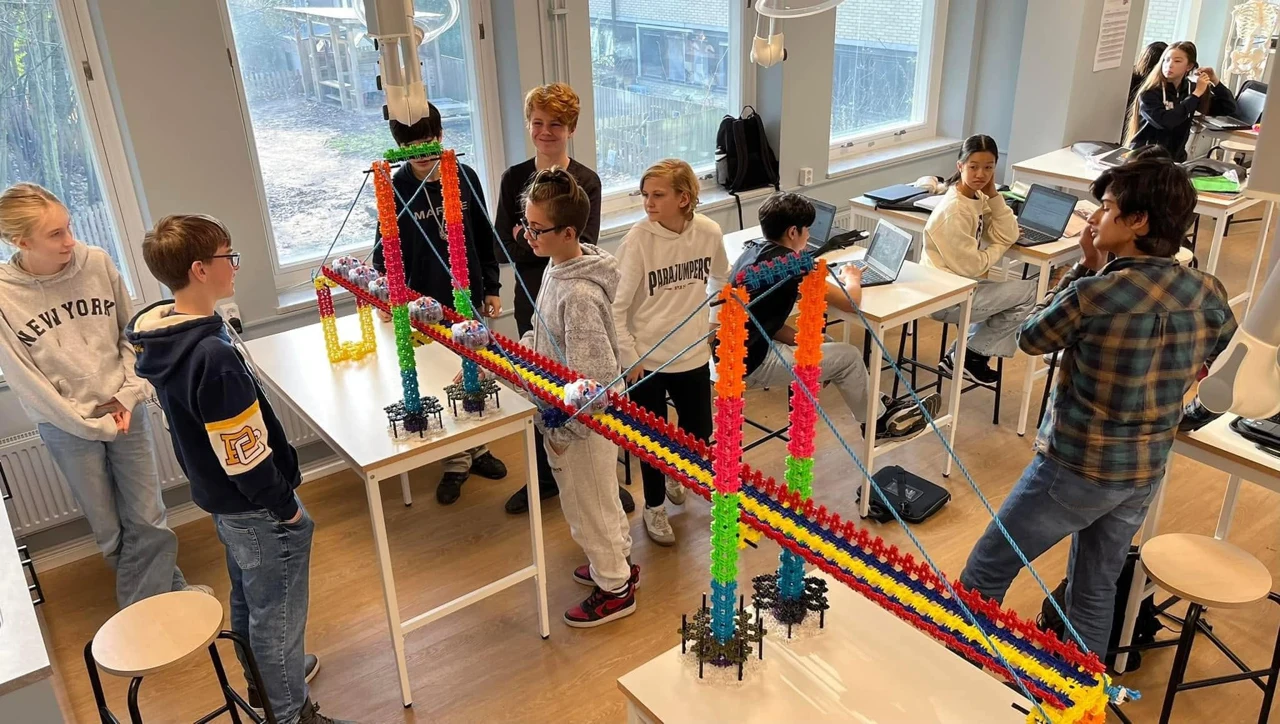
Trace the cables and supports · Classroom build Forces
Investigate tension, compression, bending and equilibrium.
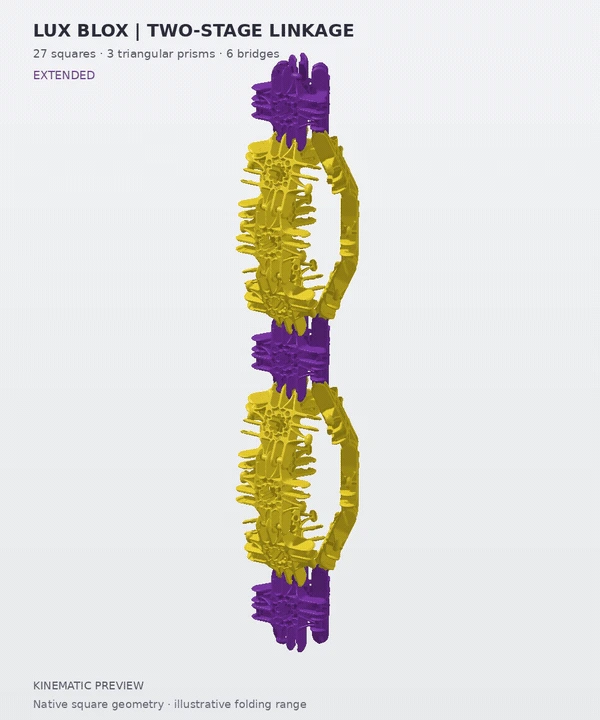
Follow the hinges as they move Mechanisms
Explore hinges, levers, gears, pulleys and linkages.
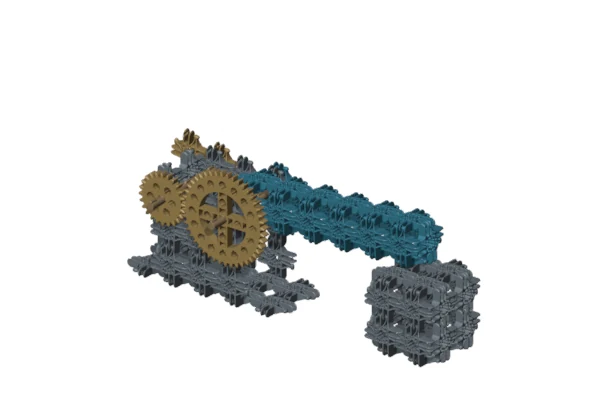
Movement with a purpose Machines
Connect mechanisms to power, control and a useful task.
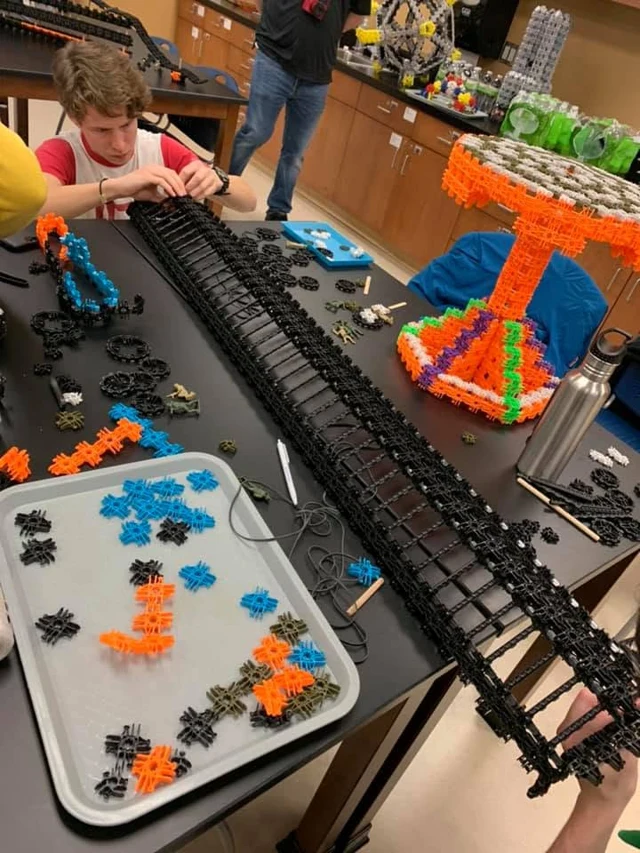
Build, test and revise · Classroom work Engineering
Work within constraints; build, measure, revise and explain.
First principle · Corrugation
Put geometry to work.
Ridges and valleys change a sheet’s section and its resistance to bending in different directions. With Lux Blox, students can investigate that relationship by rearranging familiar pieces.
Try the comparison. Use the same pieces, span and test load. Compare flat and corrugated arrangements, hold the folds in place, then measure deflection. What changed—and which way is it stiffer?
Hold the folds in place during the test so the sheet’s section stays consistent.
First principle · Tension & compression
Make a pull part of the solution.
Cables carry tension: they pull. Towers and struts can carry compression: they resist a push. Students trace the load through a construction, then investigate how added ties change its behavior.
Optimize, then explain. Keep the span, materials budget and test load fixed. Change a tie’s position or angle and compare deck deflection. Seek a better arrangement through measured evidence.
Use separate cable materials to investigate tension.
Students do not abandon the original language of construction. They expand what that language can express.
04 · Kinematics · The geometry of movement
The pieces are familiar.
The motion is a discovery.
Lux Blox’s hinged connections make motion part of the structural grammar. Students meet kinematics by following how connected parts move: joint angles, paths, constraints and the relationship between one movement and the next.
Sarrus-type folding studies make that investigation visible. The classical Sarrus linkage uses a spatial arrangement of hinges to guide straight-line motion. These Lux Blox studies invite students to predict, compare and measure folding paths.
Two-stage folding
Follow one hinge.Track a point as the column retracts. Which joints rotate, and which parts stay parallel?
Download the GIF ↓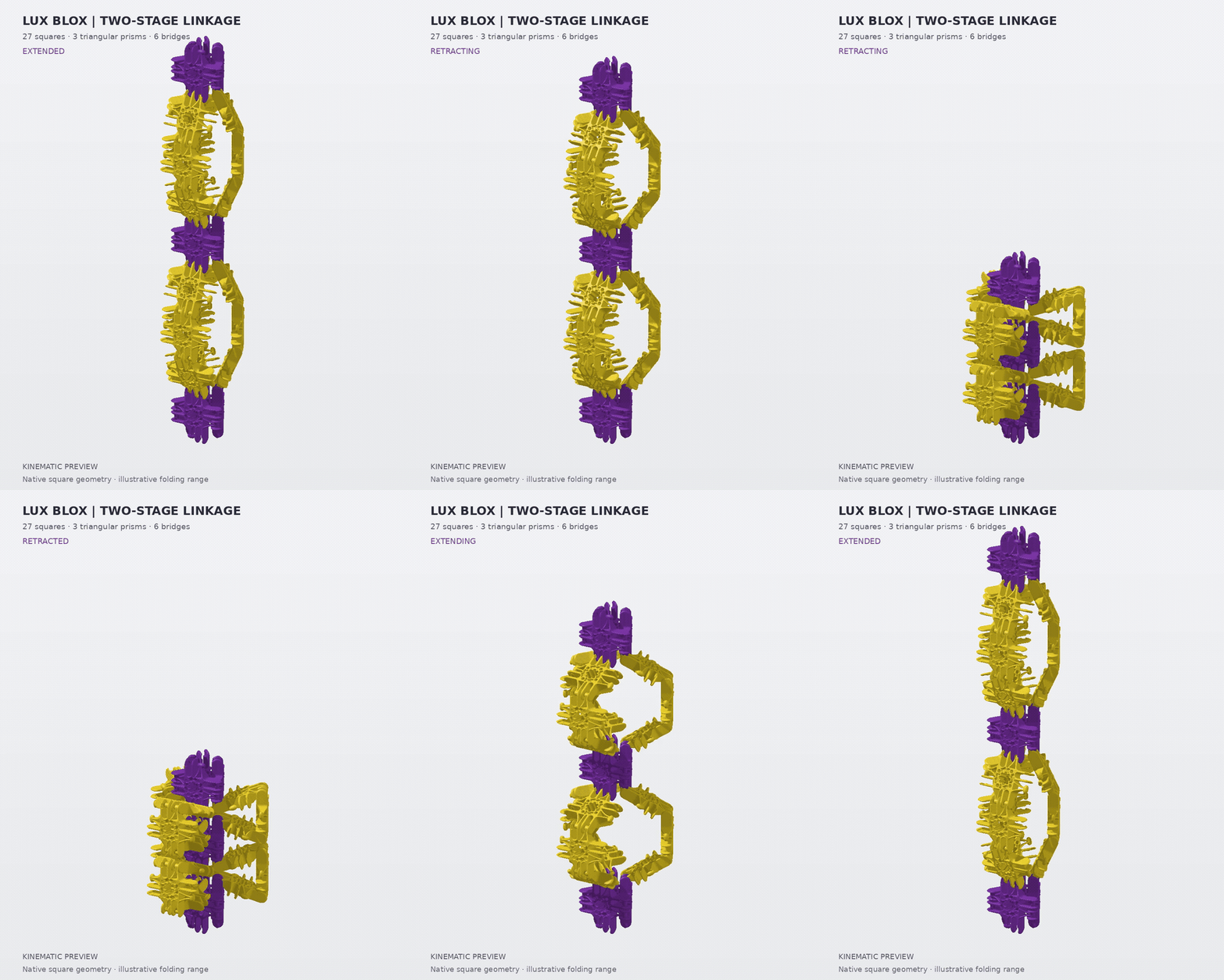
Hexagonal linkage
Change the arrangement.Compare the paths and folding range. Which relationships repeat around the column?
Download the GIF ↓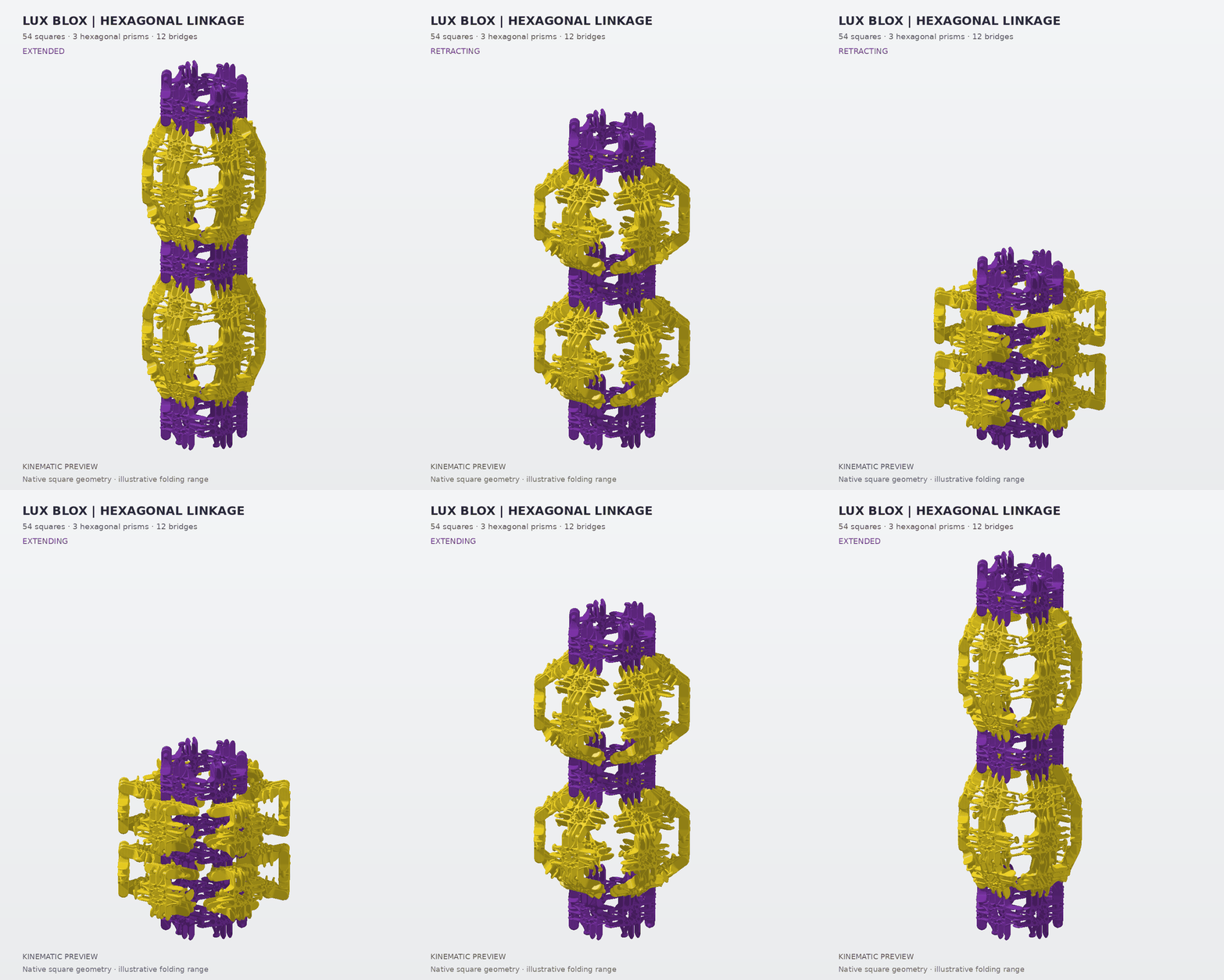
Pentagonal linkage
Repeat the moving unit.Watch several stages fold together. How would you record the change in height against a hinge angle?
Download the GIF ↓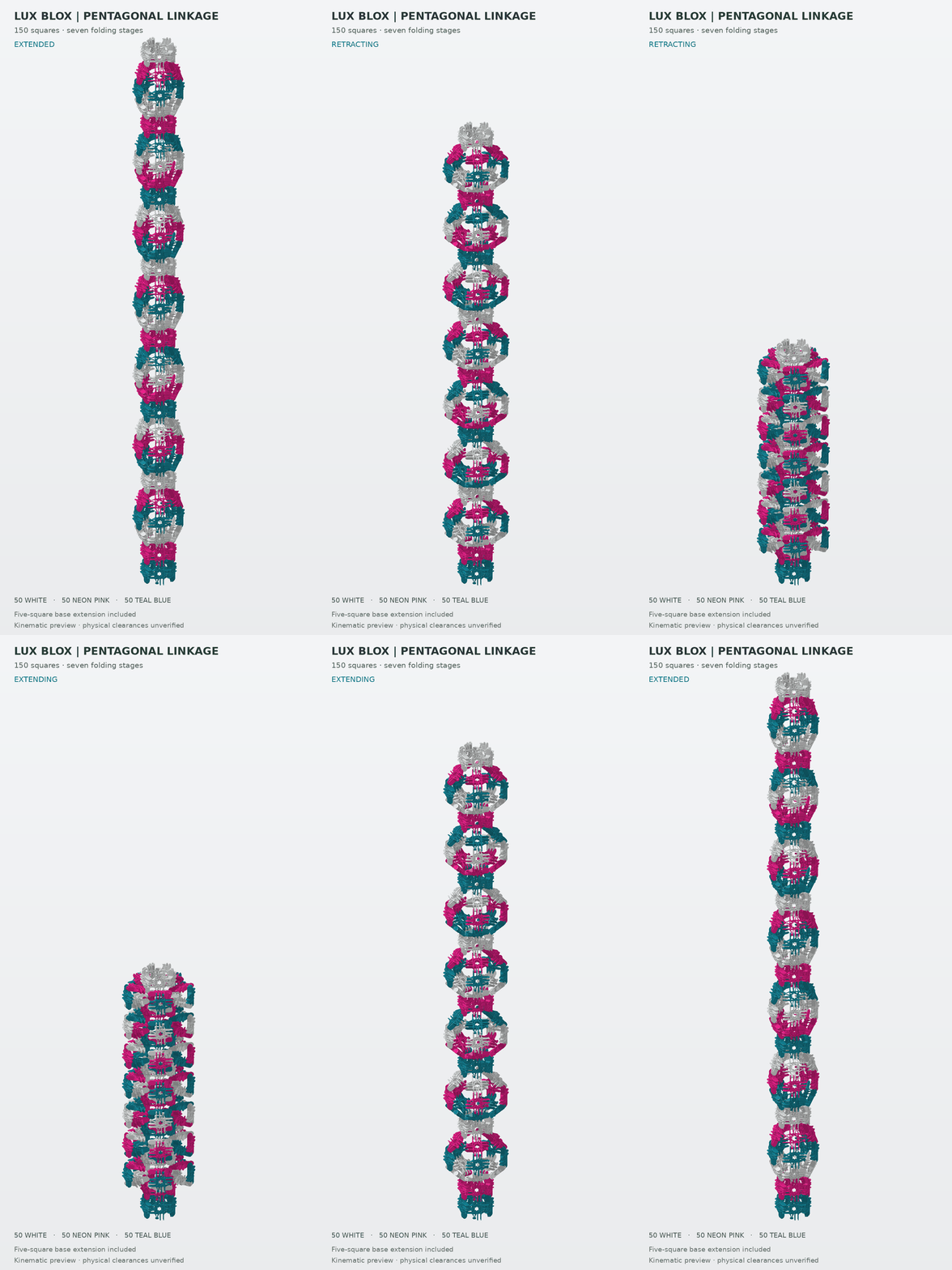
These animations invite you to predict what happens next. Build a physical model to check how the pieces fit, move and carry a load.
From “it moves” to “I can explain the motion.”
Predict a path. Mark the hinge axes. Measure an angle and the corresponding extension. Compare observations with the animation, then revise the physical model. Investigating forces and torque adds dynamics to the kinematic description.
Connect these investigations to the CTE foundation →Background for educators
For the underlying mechanism, see UC Berkeley’s linkage examples and MIT’s introduction to linkage mathematics. For classroom force investigations, see PBS Building Big: suspension bridge forces. These explain general principles, rather than validate a Lux Blox assembly.
05 · Feature project · Proposed engineering brief
One Bridge.
An Entire Engineering Classroom.
The Five-Volt Drawbridge Challenge
Design a bridge that spans a shipping channel, supports a specified load, and opens to allow a vessel to pass beneath it—using a five-volt DC motor.
A connected set of design questions.
The proposed arrangement pairs a Lux Blox truss frame and hinged deck with a tower, lifting cables and a motor-driven winch. Compound gear reduction and an adjustable counterweight are variables to investigate.
What gearing will lift the deck? How does a counterweight change the task? What must the frame resist? Use measured evidence to answer; a plausible drawing cannot establish load capacity or motor performance.
The five-volt value is the design brief, not a statement of kit contents or electrical safety certification. Confirm matched motor, power and control equipment; use teacher-approved loads and a clear movement zone.
From design to evidence
See the idea move.
Then ask what the physical test must show.
Digital studies help communicate an arrangement. Actual materials reveal friction, alignment, bending, slipping and the load a mechanism can manage.
Explore the Launch Lab drawbridge capstone →Seven disciplines from one challenge.
- Mathematics
- Ratios, geometry, angles and measurement.
- Physics
- Torque, gravity, tension and equilibrium.
- Structural engineering
- Trusses, compression and load paths.
- Mechanical engineering
- Gears, pulleys, winches and counterweights.
- Electrical engineering
- Motors, voltage, current and reversing circuits.
- Design & fabrication
- Digital modeling, prototyping and refinement.
- Scientific inquiry
- Prediction, experimentation, measurement and explanation.
The bridge is not the lesson.
The bridge is the beginning of the questions.
06 · Designed for iteration, not just assembly
Build. Break. Ask. Fix. Name.
Use a model to make and defend engineering decisions. “Break” means testing its limits through an agreed, supervised investigation—not inviting unsafe or destructive testing.
Build
Give physical form to an idea.
Break
Test its limits and observe what happens, using teacher-defined loads and safe procedures.
Ask
Investigate the forces, relationships or constraints behind the result.
Fix
Revise the design and compare the evidence.
Name
Identify and communicate the principle discovered.
A starting build opens the investigation. Predictions, observations and revisions help students move beyond following instructions toward explaining why a design does—or does not—work.
07 · From physical construction to digital design
One Structural Language.
Physical and Digital.
The Structure Smart Builder extends this approach into a digital design environment. Students can explore geometric relationships and revise arrangements before or alongside physical construction.
The current Builder supports its parts catalog, local model files and digital model exploration. Physical testing supplies evidence about real loads, friction and motor performance. Advanced CTE workflows, analysis and integrated controls remain future development.
Our goal is to connect the speed of digital iteration with the tangible evidence of physical testing.
Explore the Digital Builder →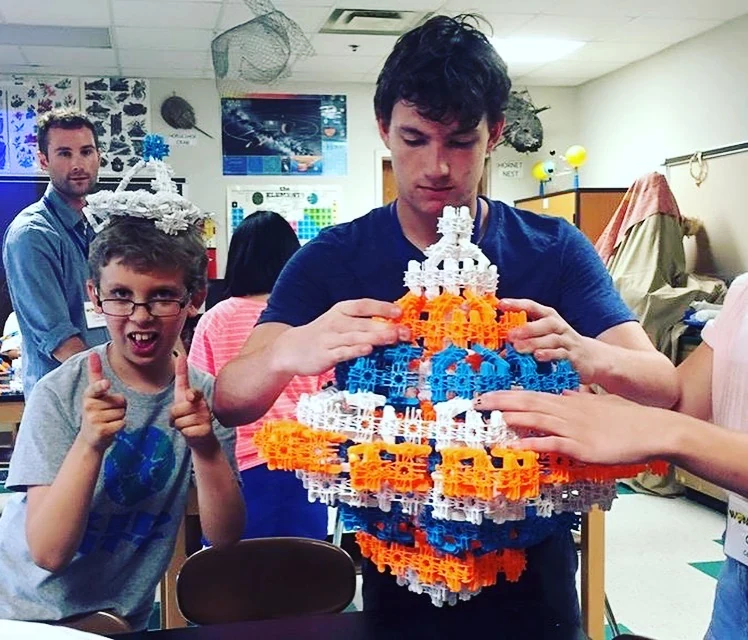
08 · A small inventory, a broad curriculum
More Learning from Every Piece.
Reuse familiar structural materials across mathematics, physics, architecture, engineering and design. Change the brief, scale or constraints to create progressively more advanced challenges. Reconnect the parts for the next investigation.
This approach is intended to make classroom organization more manageable and extend the educational range of materials. Exact inventories, additional mechanical equipment and teaching needs depend on the activity. Plan the materials and teaching support around the investigation.
We simplify the tools so students can concentrate on the complexity of their ideas.
09 · A language for invention
Learning to See
What Doesn’t Yet Exist.
The purpose of Structure Smart is to help learners recognize relationships, investigate why structures behave as they do, and use that understanding to imagine something new.
A small collection of simple elements becomes a language for experimentation and discovery. As the elements become familiar, a different question becomes possible:
“What can I make possible with what I already understand?”
From an exhibit to an investigation
You’ve seen a bridge.
Now follow the questions.
Scanned the QR at Booth 939? Start with the drawbridge challenge, then explore the connections and motion behind it.
Download the exhibit QR → Scan to explore the thinking.
Give an idea a structure.
Build it. Move it. Explain it.
Discover how a simple structural vocabulary can support rich investigations in mathematics, science, engineering and design.