A pine cone is familiar enough to pass without a second look. Draw it carefully, take it apart, and familiarity gives way to questions. Why this arrangement? What does each part contribute? What becomes possible because the parts are organized this way?
From 1989 to 1991, after college, Michael Acerra lived in a yurt in the Maine woods and devoted himself to this kind of attention. He drew and deconstructed pine cones, studied natural forms, and explored how tension could help structures achieve more with less material. His attention increasingly turned to connections: how parts meet, what movements they allow, and how those relationships affect the whole.
A question to pursue
Acerra began a thought experiment: set aside familiar names and purposes and attend to structure. What repeats? What connects? What moves together? What holds? He wondered whether this way of looking could reveal a “grammar” of relationships across otherwise unfamiliar objects. It was a starting point for investigation, a question to follow through observation and building.
He called one aspect of that inquiry constraint landscapes: the range of possibilities shaped by a system’s connections and limits. A hinge permits some movements and restricts others. A fold changes how a sheet responds to a load. The practical question became how to build with those possibilities.
From folded paper to a hinge
In 1991, one memorable step came through folding Y-shaped paper until a seed-pod form appeared. An observation of nature had become a physical experiment. The paper offered something to manipulate: a way to explore how folds and connections could produce a changing three-dimensional form.
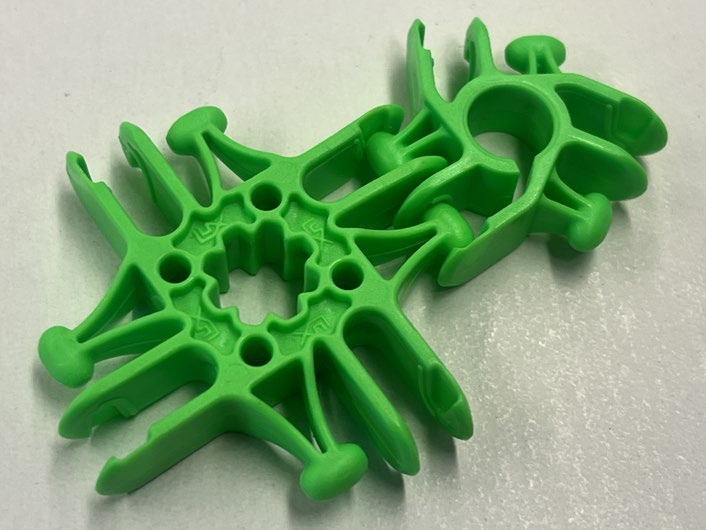
That line of investigation led to the hermaphroditic hinge at the heart of Lux Blox: identical edge designs with complementary male and female features that interlock with one another. Pieces with compatible edges can connect without a separate connector part. The patent describes this connection architecture as a “comb connector”; “hermaphroditic” describes the matching connectors, and “hinge” describes the motion of the joined pieces.
Connected pieces can move relative to each other, allowing assemblies to fold and change shape. The invention gave builders a way to pursue questions about structure through the behavior of an actual model.
From investigation to launch
- 1989–1991
Acerra lived in a yurt in Maine, studying and drawing natural forms—a period he identifies as foundational to the inquiry.
- 1991
Acerra’s Y-shaped paper-folding experiment produced a seed-pod form, an early step in the investigation that preceded formal product development.
- 2009
Michael and Heather Acerra, co-founders of Lux Blox, brought Daniel Wollin into the Lux Project—the development effort that became Lux Blox—to assist with design development, as documented in Acerra’s 2017 Bridges paper.
- October 2015
Lux Blox launched its construction system commercially under the name Lux, the principled block, documented in the founders’ Core77 design-award entry.
- May 9, 2017
U.S. Patent 9,643,101, Construction system using a comb connector, was granted.
What the Bradley collaboration is producing
An Illinois Innovation Voucher supports the Lux Blox collaboration with Bradley University on Lux Blox: Product Development toward Chemical Modeling and STEM Education. The work described here centers on chemistry and STEM education, including investigations led by Dean Campbell and Karl Jung. Read the December 2025 project announcement ↗
A dendrimer teaching module
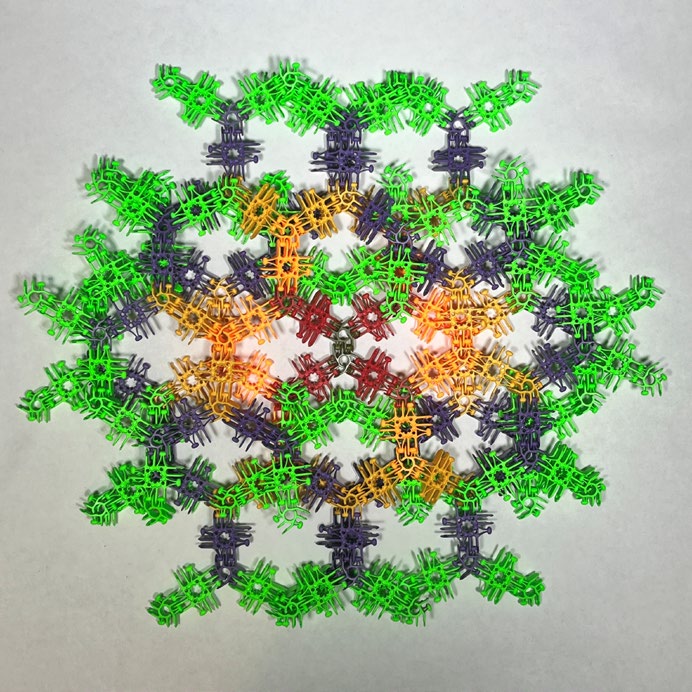
Campbell’s module models a highly branched polymer using trigons for amine-containing regions and squares for amide-containing regions. Its build sequence follows successive generations, giving students a way to count terminal groups and investigate exponential growth. An accompanying time-lapse video shows the model being assembled.
Measured connection strength
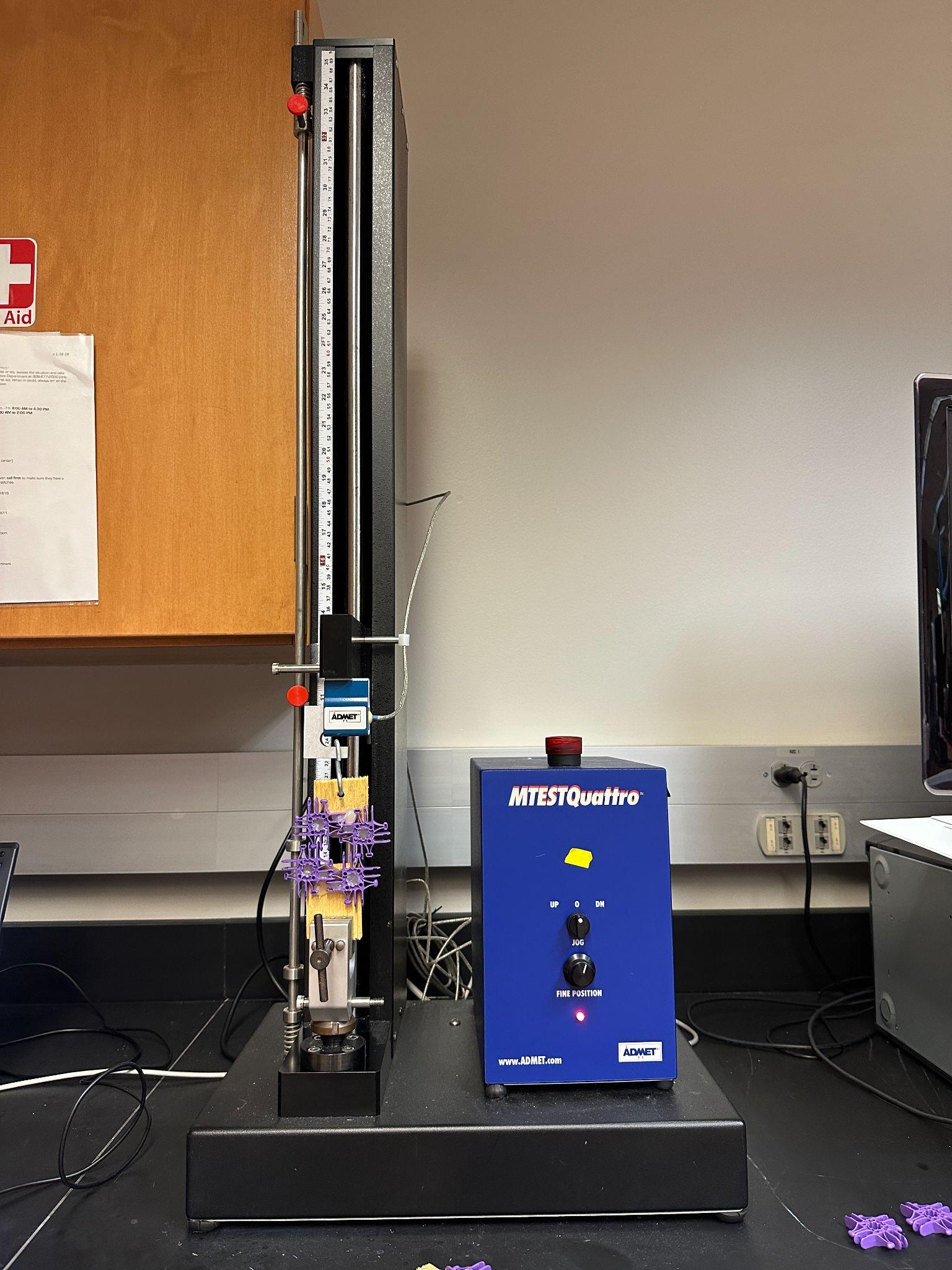
Marius Stancu, Ali Patel and Campbell compared head-on and offset Lux Blox connections using manual and motorized tensile testers. The team’s report, shared with Lux Blox, lists 10 trials per reported condition (n = 10) and reports mean force and standard deviation. Under those conditions, head-on assemblies withstood roughly twice the pulling force of offset assemblies. This is a finding from that test setup, not a general load rating.
It also recorded declining separation force with repeated testing and twisting after the first joint set separated—observations that raise further questions about wear and load redistribution.
Classroom research
Karl Jung’s work includes classroom research with a CTE teacher at a local middle school. That study brings the models into a teaching setting and provides a basis for examining classroom use. The work is ongoing; this page does not claim completed findings or measured gains in learning.
Models that lead to further questions
In a series of videos on Chem Demos, Campbell uses Lux Blox to explore chemical structures and behavior. These models let viewers examine particular relationships—branching, arrangement, flexibility—and ask how well a physical analogy explains a chemical phenomenon. The dendrimer build above plays here on this page.
The dendrimer module, the connection tests and the classroom research pursue different questions. Together they show how an inquiry can develop: observe a relationship, make it tangible, test what it does, and use the result to decide what to investigate next.
Bring a question from your field
Structure Smart University invites faculty and institutions to collaborate on pilot investigations that build on their own teaching and research. A pilot can begin with a specific concept students struggle to visualize, a structural behavior worth measuring, or a model whose usefulness needs testing.
The inquiry that began with close observation in Maine continues through this work. Its value lies in the questions it makes possible—and in what careful investigation can establish.